Showing posts with label Library of Congress. Show all posts

Tuesday, November 1, 2022

Happy 125th Anniversary Book Palace of the American People


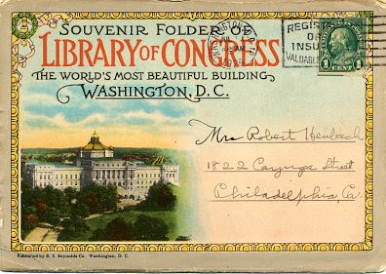
On November 1, 1897 the new Library of Congress building opened to the public. Ainsworth Rand Spofford, the sixth Librarian of Congress who was largely responsible for getting the building built, referred to it as the "Book Palace of the American People". Some even claimed that it was "The World's Most Beautiful Building". The building was renamed the Thomas Jefferson Building in 1980. IMHO it should have been named the Ainsworth Rand Spofford Building. I am a collector of a wide variety of artifacts that feature the 1897 building. One of the indicators of the beauty and importance of the building is the number of picture postcards that feature the exterior and interior of the building. On a recent search of eBay there were over 2,000 Library of Congress postcards listed which is more than any other library. I have over 150 in my personal collection of library postcards. There are also a large number of other souvenir items that feature the building. The history of the Library of Congress building coincides very well with the history of picture postcards. There are excellent examples of Library of Congress postcards for every postcard era. Here are a few from my collection.

PIONEER ERA (1873-1898)

1894 U.S. Post Office issue postal card. Mailed to Freiburg, Germany on Nov. 7, 1897, only 6 days after Library of Congress building opened to the public.


PRIVATE MAILING CARD ERA (1898-1901)

Mailed via the S.S. Kronprinz Wilhelm to Floha, Sachsen, Germany on April 5, 1902 just 7 months after its maiden voyage.
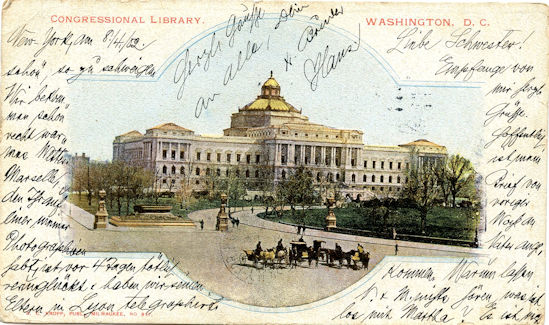


UNDIVIDED BACK / POST CARD ERA (1901-1907) 

Washington, DC to Hagerstown, MD, Sept. 27, 1906.


DIVIDED BACK ERA (1907-1915) GOLDEN AGE OF POSTCARDS

Washington, DC to Lyon, France, April 21, 1908. Images of exterior and reading room.


WHITE BORDER ERA (1915-1930)

Great Falls, VA to Canton, NJ, Aug. 2, 1929. 


LINEN ERA (1930-1945)

Unmailed. 1940 date on back.


CHROME ERA (1939-PRESENT)

 Unmailed.


REAL PHOTO POSTCARD (RPPCs) (1900-PRESENT) 

Unmailed.


Thursday, June 30, 2022

1850s Library of Congress Copyright Envelope


I've been collecting Library of Congress postal items for over 25 years. These items contitute a postal history of the Library of Congress. Items mailed by or on behalf of the library before 1860 that still exist are rare. Before I acquired the envelope shown above, I had only seen one other postal item mailed by the library before 1860. Obviously I was excited to add it to my collection. The envelope is identified as being mailed by the Library of Congress by the notation or docket on the left side of the envelope. It reads "Librarian of Congress recpt of our Copy Right articles". The envelope was mailed between 1851 and 1854 to Messrs Troup and Fickardt in Circleville, Ohio. George Fickardt and J.A. Troup were druggists in Circleville. The mailing period is established because their partnership only existed from about 1847 to 1854. Additionally, the 5 cent postal rate shown in the postmark went into effect on July 1, 1851 for unpaid postage (to be paid by the recipient). 

The envelope is also of significance in regard to the impact of copyright laws on the Library of Congress. An August 10, 1846 act of Congress authorized the Library of Congress to receive as a deposit one copy of each copyrighted "book, map, chart, musical composition, print, cut or engraving." Because that requirement had no enforcement provision and was largely ineffective it was repealed by an act of Congress on Feb. 5, 1859. An act on March 3, 1865 reinstituted a requirement that the Library of Congress receive one copy of each copyrighted item. On July 8, 1870 President Grant approved an acto Congress that centralized all U.S. copyright registration and deposit activities at the Library of Congress. The implementation of the 1870 law resulted in an enormous expansion of the use of the mail be the Library of Congress. I have developed a philatelic exhibit on the administration of copyright by the Library of Congress during the period 1870 to 1930. 

I have over 50 other blog posts related to the Library of Congress.

Thursday, April 21, 2022

The 1982 Library of Congress Stamp

On this day (April 21, 1982) forty years ago the United States Postal Service issued a stamp honoring the Library of Congress. It was significant in that it was the first United States stamp to specifically honor a library. Although there had been previous postage stamps on which library buildings had appeared, those were issued to commemorate academic and other institutions or architects. Originally, the proposed stamp was to commemorate all of America's libraries collectively and the Library of Congress individually. Librarian of Congress Daniel J. Boorstin wasn't happy with the design of the stamp, however, and the Postmaster General agreed to issue a separate stamp for the Library of Congress. The stamp honoring America’s Libraries collectively was issued on July 13,1982 at the conference of the American Library Association in Philadelphia. Both stamps were designed by noted graphics designer Bradbury Thompson. I have a large collection of first day covers for both stamps. One of my favorites for the Library of Congress issue is shown above. It was the Library of Congress Philatelic Club Cachet Number 1. The illustration on the envelope (called a cachet) is a pen and ink drawing by Paul Boswell.  Boswell was a staff member at the Library of Congress where he worked for 46 years. Bowell was also a poet and in 1994 Boswell published a book of his poems and drawings titled No Anchovies on the Moon: Three Score and Ten Washington Pictures and Poems. Boswell died in 1994. The first day cover is signed by Boswell and Librarian of Congress Daniel J. Boorstin. 

The Library of Congress Philatelic Club produced first day covers for 18 different stamp issues. Their second first day cover cachet was for the America’s Libraries stamp.

I also published a blog post on the 30th anniversary of the issue of the Library of Congress stamp.


Thursday, April 7, 2016

Philatelic Exhibit about the Library of Congress

This past weekend I displayed a major revision of my philatelic exhibit about the Library of Congress at the Saint Louis Stamp Expo. I was rewarded with a gold medal and the Best Display Exhibit award.  Display exhibits are those that include non-philatelic as well as philatelic elements in the exhibit, usually ephemera related to the topic of the exhibit. The items in the exhibit are mounted on ninety-six 8 1/2 by 11 inch pages displayed in special exhibit frames. I’ve been collecting philatelic and other items related to the Library of Congress for more than twenty years. Of particular significance in the exhibit are those items that document the role that mail played in the operations of the Library of Congress.  I will also be displaying the exhibit at the Danepex stamp show in Madison on April 10, the first day of National Library Week, and later in the month at Wiscopex in Fond du Lac, WI. I will also show it in a couple of other national level shows later this year. This is my thirteenth year of displaying library related exhibits at stamp shows. Although my primary impetus for exhibiting at stamp shows has been the promotion and appreciation of library history, I’ve been delighted to have my efforts recognized in a positive way by the philatelic community.

Friday, March 11, 2016

Librarian of Congress A.R. Spofford, 1875 Letter


Librarian of Congress Ainsworth Rand Spofford who served from 1864 to 1897 was the first librarian to select and purchase books. Formerly this had been done by the members of the Congressional Joint Committee on the Library. In the letter above dated May 15, 1875 Spofford negotiates the purchase of a book for the library's collection. Spofford writes to M.M. Jones of Utica, NY: " A French gentleman of this city informs me that you have 2 copies of the "New York Balloting Book" folio 1825 which you offer at $5 each. My informant not wishing to purchase asked if this Library world make the purchase for its shelves. If you will send a copy of the work with bill of the same at $5 the amount will be promptly submitted."  It is extraordinary that Spofford with so many demands on his time would engage in a transaction involving a single book. Spofford is writing on stationery of the Copyright Office of the Library of Congress. The responsibility for copyright had been transferred to the Library in 1870. This letter which is part of my collection will be included in a philatelic exhibit that I'm working on about the Library of Congress. 

Monday, August 24, 2015

1862 Library of Congress Envelope


This weekend I attended StampShow 2015 sponsored by the American Philatelic Society in Grand Rapids, MI. This is the largest annual stamp show in the nation. Over the years a small cadre of philatelic dealers have been thoughtful enough to save items related to my collecting interest of postal librariana until the next time they see me at a stamp show. Several of these dealers were at the Grand Rapids show. One dealer (thanks Doug) was holding an especially nice item for me. It is an envelope (shown above) mailed by Ainsworth Rand Spofford at the Library of Congress on March 13, 1862 to Washington, D.C. bookseller P.R. Fendall. At the time Spofford was Chief Assistant Librarian of Congress. He became Librarian of Congress in 1864 and served in that capacity until 1897. The envelope has an embossed Library of Congress return address and has a hand written notation indicating that it contained a letter from Spofford and that Fendall had sent the books which Spofford had requested. I have a large collection of postal items related to the Library of Congress and have a philatelic exhibit of these items. This envelope is special because it is the first one I have seen which includes a postage stamp and was mailed prior to 1870. Mail sent by the Library of Congress was limited before the library was authorized to handle the copyright function on behalf of the United States in 1870. For much of its early history the Library of Congress made use of the free franking privilege of members of congress for its outgoing mail. After 1877 the Library of Congress used a special category of stampless mail for government agencies referred to as “penalty mail” because of the statement on envelopes threatening a penalty for private use. I’m revamping my Library of Congress exhibit and this envelope will make a very nice addition.

Thursday, July 2, 2015

Darkest Day for the Library of Congress?


It might be said that the darkest day in the long history of the Library of Congress was August 24, 1814 when the British army burned the U.S. Capitol including the collection of the Library of Congress which was housed there. I have written previously about this occasion and the role played by Patrick Magruder, Librarian of Congress, during this event. I’ve recently added another artifact to my collection related to Magruder’s role in the destruction of the Library of Congress. It is the December 12, 1814 Report of the Committee “To whom was referred the communication of Patrick Magruder, Clerk of the House of Representatives, relative to the destruction of the library, &c.”. Magruder served in the dual capacity of Clerk of the House of Representatives and Librarian of Congress. The communication referred to was Magruder’s account of the actions of his office during the events leading up to destruction of the library and the records of the Clerk’s office.  In the report, the committee expressed the opinion, “that due precaution and diligence were not exercised to prevent the destruction and loss which has been sustained.” At the time of the destruction, Magruder himself was absent “on account of indisposition”. In the report the committee seemed skeptical about his indisposition and indicated that it “ought to have been, serious and alarming to have justified his absence under the circumstances which then existed.”  During the destruction of the Capitol the financial records of the Clerk were destroyed and the committee in reconstructing these came to the conclusion that a balance of $19,874 was unaccounted for and due the United States. Although Magruder managed to avoid being prosecuted for these missing funds, he resigned on January 28, 1815. The destruction of the Library of Congress led to the purchase of Thomas Jefferson’s library to replace the destroyed collection. 

Wednesday, December 24, 2014

An Interesting Bookmobile Postcard


The postcard above depicting the bookmobile of the Albuquerque (NM) Public Library was given to me by Norman Stevens, one of the world's greatest library postcard collectors. Norman donated his collection of approximately 25,000 library postcards to the Canadian Centre for Architecture and it is now part of the Norman D. Stevens Collection of Library Architecture. This one got left out of the CCA donation. I'm grateful to have the postcard since it was part of Norman's collection. It also has several other aspects that are of interest to me. I collect bookmobile postcards so obviously that's the first aspect that is of interest. The postcard is larger than the usual postcard of this period (1950s). It is 6 1/4 inches wide instead of the usual 5 1/2 inches, and it is 4 1/2 inches high instead of the usual 3/12 inches. It is an advertising postcard from The Gerstenslager Co. of Wooster, OH, the largest maker of bookmobiles for several decades. The postcard was mailed to Lucille Morsch of the Library of Congress and received by LC on Jan. 26, 1959. Since I am also a collector of postal librariana related to the Library of Congress, this is also of special interest to me. In Norman D. Stevens' book A Guide to Collecting Librariana (Scarecrow Press, 1986) he mentions that Lucille Morsch was a collector of library postcards and that she donated her collection to him before her death. This is probably why the bookmobile postcard was in his collection. It also means that the postcard is now in the hands of the third library postcard collector (me). 

Tuesday, August 5, 2014

Mr. Jefferson's Library


This is a follow-up to the previous post about the bicentennial of the burning of the Library of Congress. As I mentioned in the post, the destruction of the collection of the Library of Congress led to the eventual purchase of the library of Thomas Jefferson. Jefferson first offered to sell his library as a replacement for the destroyed collection in a letter to Samuel H. Smith on September 21, 1814.  In the letter Jefferson asks Smith to submit his offer to the library committee of Congress. A copy of the letter was published in the Niles' Weekly Register of October 20, 1814. I have a copy of that issue of the Niles' Weekly Register for that date in my collection and Jefferson's letter is shown above. Jefferson's library which was eventually sold to Congress for $23,950 consisted of 6,487 volumes, more than double the number of volumes lost in the fire. A more complete account of Jefferson's library and its conveyance to Congress is contained on the Library of Congress website. There is also a link on the site to the original hand written letter from Jefferson. Also check out the Thomas Jefferson page on LibraryThing.

Jefferson. 

Monday, August 4, 2014

Bicentennial of the Burning of the Library of Congress

Illustration from Harper's New Monthly Magazine (Dec. 1872) showing British burning books from the Library of Congress in 1814
Cover of 1814 letter describing the burning of Washington
Notation on cover
This month marks the 200th anniversary of the burning of the U.S. Capitol including the Library of Congress by the British during the War of 1812. On August 24, 1814 the British captured the City of Washington and burned the Capitol, the White House, and other public buildings. The entire collection of the Library of Congress which was located in the Capitol was destroyed. It totaled just over 3,000 volumes. The destruction of the collection of the Library of Congress led to the purchase of the library of Thomas Jefferson for $23,950 to replace it. One of my most prized postal artifacts is a cover for a letter (see above and at left) describing the "particulars of burning of Washington by Bristish ..." which was mailed by Samuel Taggert, a member of the House of Representatives, on Oct. 20, 1814. I only have the cover not the actual letter. I wrote a previous post about the role (more accurately the lack of a role) by Librarian of Congress Patrick Magruder during the attack on Washington. The Library of Congress website has more about Magruder. 

Thursday, April 10, 2014

Exhibits for National Library Week

Library of Congress exhibit at Hartford, WI library
Wisconsin library memorabilia exhibit at Suring, WI library
One of the more enjoyable activities in my efforts to promote library history is displaying portions of my collection of librariana at libraries around Wisconsin. I do this under the auspices of the Wisconsin Library Heritage Center, a program of the Wisconsin Library Association Foundation. This year the exhibits are being displayed at fourteen different public libraries around the state. To help celebrate National Library Week which runs from April 13 to April 19 exhibits will be on display for the month of April at two very different public libraries - the Jack Russell Memorial Library in Hartford, WI and the Suring Area Public Library in Suring, WI. The Hartford library is located in the southeastern part of the state and serves more than 30,000 people and and occupies a large new facility. The Suring library is located in northeastern Wisconsin and serves about 3,800 people and is housed in a joint use facility with several other village departments. The exhibit at the Hartford library features memorabilia and souvenirs for the Library of Congress.  The exhibit occupies a small display case prominently located in the front of the circulation desk. The exhibit at the Suring library features memorabilia for Wisconsin libraries. The Suring library has four nice display cases located in the lobby of the joint use facility and the cases were large enough to display a significant portion of my Wisconsin library memorabilia collection.  My wife Kathy helps me with the exhibits and we had a wonderful early Spring drive up North to Suring which still had lots of snow and lakes frozen enough to support cars and trucks for ice fishers. Our exhibits are available to libraries on a first come first serve basis regardless of size and we have had exhibits at the metropolitan Milwaukee Public Library and at libraries in communities even smaller than Suring. Every library has a different display case configuration which represents an interesting challenge each time we install the exhibits. The exhibits are always appreciated by the libraries and their users which makes it all worth while. 

Wednesday, December 25, 2013

1906 Library of Congress Christmas Postcard


I recently acquired the postcard shown above which has another library winter scene (see other library winter scenes). It is a scene from the steps of the Library of Congress, and it was mailed on December 25, 1906. The message reads: "Your gift is received. May your Merry Christmas be followed by a Happy New Year." My sentiments exactly.

Tuesday, September 3, 2013

1931 Postal Card to the Library of Congress


One of my favorite categories of postal librariana is pre-stamped government issued postal cards. Libraries made heavy use of these cards to conduct library business, and they provide an interesting look at library procedures of the past. The postal card (see above) featured in this blog post concerns interlibrary loan and was mailed to the Library of Congress by the Cornell University Library on August 14, 1931. The hand written note on the message side of the card indicates that three books borrowed on interlibrary loan are being returned "express prepaid". A notation at the top of the cards indicates that the books were received by the Library of Congress. The front of the card has several special markings. All mailed received by the Library of Congress was stamped with a date received stamp by the Mail & Delivery Division. In addition to that stamp this card has a date received stamp for the Secretary's Office. There are also "Reading Room" stamps and an "Inter-Library Loan" stamp. Interlibrary loan was initiated by Librarian of Congress Herbert Putnam in 1900. It was a major factor in establishing the Library as a national library and not just a library for Congress.

Tuesday, April 2, 2013

Library of Congress Exhibit

April is the month that we celebrate National Library Week. This year it is April 14 -20. I'm helping to celebrate this event with an exhibit about the Library of Congress at my local library, the Middleton (WI) Public Library. It features various items from my collection related to the Library of Congress. It will be on display for the entire month of April. Some images of the exhibit are shown below.


Saturday, February 2, 2013

Patrick Magruder and the Burning of the Library of Congress

 Patrick Magruder (1768-1819) was the second Librarian of Congress and served in that capacity from 1807-1815. He served both as the Clerk of the House and as Librarian of Congress as had his predecessor. Magruder had the misfortune of serving in those capacities at the time the Capitol of the United States was burned by the British during the War of 1812. At the time of the burning of the Capitol in August of 1814 Magruder was absent from Washington, D.C. for health reasons. He left the Office of the House and the Library of Congress in the charge of his brother George Magruder and two assistants. In addition to the books in the Library of Congress Patrick Magruder's office records which included the financial records of the House of Representative were destroyed. A Congressional investigation into Magruder's handling of Congressional funds found discrepancies including a shortage of $20,000. Although Magruder managed to avoid prosecution for his actions, he resigned on January 28, 1815. I have in my collection an 1814 government publication which contains a letter from Patrick Magruder to the Speaker of the House in defense of his actions which in turn includes an account by two office assistants of the events leading to the destruction of the Office of the House and the Library of Congress. Their account says in part, "every thing belonging to the office, together with the library of congress, we venture to say, might have been removed in time, if carriages could have been procured, but it was altogether impossible to procure them, either for hire or by force." After Magruder's resignation the positions of Clerk of the House and Librarian of Congress were separated. The source of the information in this post is the Library of Congress website.

Sunday, June 24, 2012

Solberg, Woods, and the Library of Congress


Thorvald Solberg (1852-1949) was the nation's first Register of Copyrights in the Library of Congress. He served in that capacity from 1897 to 1930. Harriet de Krafft Woods served in the Copyright Office of the Library of Congress from 1900 to 1922. In May of 1922 she was appointed by Congress as Superintendent of Buildings and Grounds for the Library of Congress, the first woman to serve in that capacity. I recently acquired a postcard that ties these two individuals together in an unusual way. The postcard which depicts Wisconsin Street in Milwaukee, WI was mailed by Henrietta Solberg, Thorvald Solberg's sister, on August 1, 1904 to Mrs. Woods in the Copyright Department of the Library of Congress. The messages on the postcard reads: "Dear Mrs. Woods, Please send my brother's address to 742 N. Hoyne Av., Chicago and greatly oblige. Yours sincerely, Henrietta Solberg". Woods at the time may have served as an assistant to Solberg. She would eventually work her way up to become head of one of the Copyright Office's most important divisions. It is unclear why Solberg's sister didn't have his address. Perhaps he was out of the country on one of his numerous trips abroad. Woods only held the position of Superintendent of Buildings and Grounds for one month, from June 1, 1922 to July 1, 1922. That is because Congress abolished the position as a position appointed independently of the Librarian of Congress. Woods, however, continued to perform the responsibilities for the position as an administrative assistant to Herbert Putnam, the Librarian of Congress.  In his report for 1922  Putnam indicated that this change was one of the most significant events of the year. Also in his report, Putnam sang the praises of Woods.

Tuesday, June 19, 2012

Libraries With the Most Librariana


If you follow this blog, you know that I am a collector of librariana. Although my primary emphasis is on the collection of postal librariana, I collect a wide range of other library souvenirs and memorabilia. The golden age of  souvenirs is generally considered to span the period from the 1893 World's Columbian Exposition in Chicago to the start of World War I. Coincidentally, this was the period when a large number of library buildings were constructed in the United States. This resulted in many souvenirs depicting library buildings, and the more prominent and spectacular the building, the more souvenirs there were that depicted the building. Souvenirs included postcards, decorative china, spoons, and a large variety of other items. Hands down, the library building that is most depicted on library souvenirs is the Thomas Jefferson Building of the Library of Congress which was completed in 1897. On its completion it was often characterized as one of the most beautiful buildings in the world. The Copley Square building of the Boston Public Library, completed in 1895, was a landmark in library construction and influenced library architecture for several decades. The Boston Public Library is one of the top three U.S.libraries with the most librariana. The Central Library of the New York Public Library completed in 1911 is the final member of the trio of libraries with the most librariana. In a recent eBay search there were 531 items related to the Library of Congress in the collectibles category; 470 related to the New York Public Library; and 392 related to the Boston Public Library. The largest portion of these items by far was postcards although there were also souvenir spoons and china.  Norman D. Stevens in A Guide to Collecting Librariana (Scarecrow, 1986) confirms that the Library of Congress and the Boston Public Library are the libraries most widely represented on library souvenirs. Stevens' personal collection which included many examples of librariana related to these three libraries is now located at the Canadian Centre for Architecture in Montreal. I have a listing of his collections at the CCA on a web page devoted to him. Some of the items in my collection depicting the Library of Congress are shown above. Images of items in my collection related to the Boston Public Library are located HERE. In Wisconsin the two libraries most widely depicted on librariana are the Milwaukee Public Library and the Wisconsin Historical Society Library. Some of the items in my collection related to the Milwaukee Public Library are located HERE.

Saturday, May 26, 2012

Mail Art


It doesn't take much to send me off on a tangent. This time it was a small label (2 3/4" x 3 1/2") which requested information about publications related to mail art. The label was distributed by John Held, Jr of the Fine arts Division of the Dallas Public Library in 1988 and was designed to be affixed to an envelope. Held's purpose was to develop "An Annotated Bibliography of Mail Art".  Held received hundreds of responses to his request and later published the results in the book Mail Art: An Annotated Bibliography (Scarecrow Press, 1991). What is mail art? [see Wikipedia's answer] [see Oberlin College's answer] Mail art encompasses a broad range of art forms. There is, of course, the official mail art of governments which takes the form of postage stamps. Artists and graphic designers from around the world design thousands of these each year. I had an earlier post about my favorite library postage stamp designer Bradbury Thompson. Another common mail art form is illustrated envelopes that are designed by cachet makers for the first day of issue of a new postage stamp. These are commonly called first day covers. I have hundreds of first day covers for library postage stamps in my collection. One of my favorite first day covers is for the 1982 Library of Congress postage stamp which is shown above. It was hand painted by cachet maker Judith Fogt. There is a more avant-garde aspect to mail art, however, and John Held is one of the foremost authorities on this genre of mail art. This format includes artistamps which are postage stamp like depictions that often carry an underlying message. Oberlin College has a collection of over 25,000 pieces of mail art. Some examples from their collection is located HERE. There's a nice variety of mail art depicted on this Pinterest site. The Library of Congress Center for the Book's Letters About Literature site has some interesting envelope art. Back for a moment to John Held, Jr. While at the Dallas Public Library, Held curated a major exhibit of library rubber stamps which I wrote about in this blog post.

Tuesday, April 24, 2012

Herbert Putnam and ALA's Library War Service

The United States declared war on Germany and entered World War I ninety-five years ago this month. In the same month Herbert Putnam, Librarian of Congress, initiated events that led to the creation of the American Library Association's Library War Service, perhaps ALA's most ambitious and successful undertaking in its history. According to Arthur P. Young in Books for Sammies: The American Library Association and World War I (Beta Phi Mu, 1981), Putnam presented his idea of furnishing books to the American army in a meeting with Secretary of War Newton D. Baker who responded positively to the idea. Following that meeting, the ALA Executive Board established a Committee on Mobilization and War Service Plans and Putnam was appointed chair of the committee on April 30, 1917. Putnam presented the committee's recommendations at ALA's annual conference on June 22 in Louisville, KY. The committee felt that an ALA operation on a "vast scale" was desirable. ALA members responded favorably to the recommendations of the committee, and at the end of the conference ALA President Brown appointed a permanent War Service Committee headed by James I. Wyer. Putnam assumed the leadership for the administration of the ALA Library War Service while continuing as Librarian of Congress. The Library War Service was administered from a conference room in the Library of Congress. Putnam managed the Library War Service until December 13, 1919. Young writes about Putnam's role: "Few individuals are indispensable, but it is difficult to imagine another librarian who could have galvanized the Association's war program as Putnam did. Self-assured, meticulous, and urbane, Putnam was a formidable administrator and an equally good judge of character. He was able to identify and to attract to his staff many of the nation's most promising librarians who were at the threshold of distinguished careers." Jain Aikin Rosenberg in The Nation's Great Library: Herbert Putnam and the Library of Congress, 1899-1938 (Univ. of Illinois Press, 1993) also discusses Putnam's role with the Library War Service. She notes one negative aspect of that role. When selecting camp librarians, Putnam refused to consider applications from African Americans, German Americans, or women. A female librarian was finally hired in May, 1918 shortly before eight "angry female librarians protested the War Service employment policy at the ALA conference that summer."

Thursday, April 12, 2012

30th Anniversary of America's First Stamp Commemorating a Library


Thirty years ago during National Library Week in April, 1982, the United States Postal Service issued a postage stamp commemorating the Library of Congress. Although there had been previous postage stamps on which library buildings had appeared, those were issued to commemorate academic and other institutions or architects.  Originally, the proposed stamp was to commemorate all of America's libraries collectively and the Library of Congress individually. A publicity photo of that stamp is shown above. Librarian of Congress Daniel Boorstin wasn't happy with the stamp, however, and the Postmaster General agreed to issue a separate stamp for the Library of Congress. That stamp is shown at the left. The America's Libraries stamp was issued in July of 1982 during the ALA Conference in Philadelphia. Both stamps were designed by noted graphic designer Bradbury Thompson. I wrote an earlier post about Thompson on the 100th anniversary of his birth. I wrote an article about the two 1982 library stamps in the August, 2007 issue of American Libraries for the 25th anniversary of the stamps. Both stamps appear of the First Day Cover for the America's Libraries stamp shown below. It is signed by both Daniel Boorstin and the ALA President Betty Stone. To see other U.S. libraries on stamps click HERE.